I’m delighted that Traces of Play has been selected for performance at the New York Electroacoustic Music Festival 2018. I’m also really excited to be able to attend the festival and diffuse my music.

I’m delighted that Traces of Play has been selected for performance at the New York Electroacoustic Music Festival 2018. I’m also really excited to be able to attend the festival and diffuse my music.
On Wednesday 28th February 2018 guest composer Dr Annie Mahtani, University of Birmingham and Birmingham Electroacoustic Sound Theatre (BEAST), featured in a concert of multi-channel electroacoustic music at Bournemouth University. Organised by myself, and with support from the EMERGE and Creative Technology research groups, the varied programme featured works from BEAST and Bournemouth University composers.
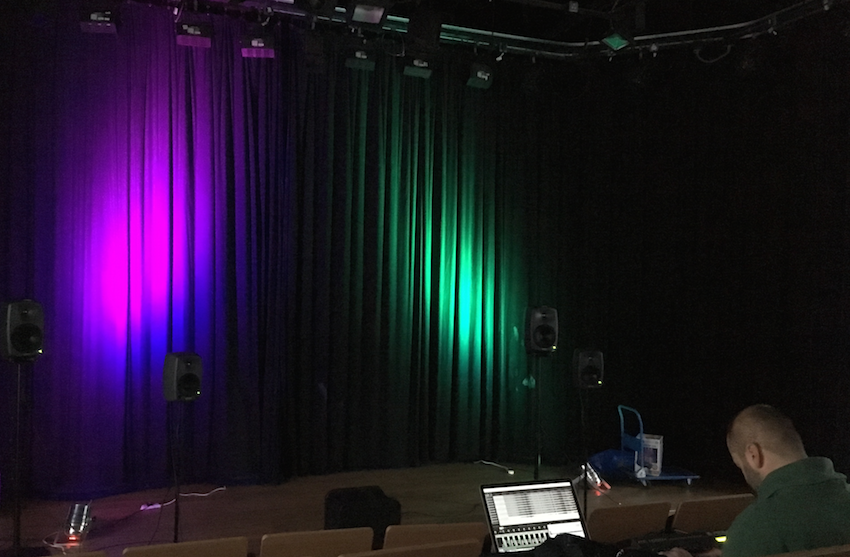
Annie Mahtani presented and diffused three compositions (Inversions; Past Links; Aeolian) along with works by fellow BEAST composers James Carpenter (Pent-Up) and Nikki Sheth (Orford Ness). I diffused my recent multi-channel electroacoustic work Traces of Play whilst my colleague Panos Amelidis (pictured here sound-checking) diffused two compositions: Bird Train and Cracks.
Student volunteers from the BSc Music & Sound Production Technology degree at Bournemouth University provided crucial help rigging the loudspeaker system.
Thanks to all who attended and persevered despite the cold conditions!
I recently curated and organised a concert of music for cello and electronics at Bournemouth University, supported by the Creative Technology and EMERGE research groups. Taking place on Wednesday 1st November 2017 in the Allsebrook Lecture Theatre, Talbot Campus, the evening featured music and performances from Laura Reid & Tom Davis, Alice Eldridge & Chris Kiefer, and Thomas Gardner .
 The programme included The Feral Cello performance system developed by Tom Davis (Creative Technology; EMERGE), for which composer/cellist Laura Reid has created a new work, Gemmeleg (2017). Tom’s system incorporates machine listening and actuated feedback to alter the response of an acoustic cello in real time during a performance.

Thomas Gardner (London College of Communication) performed his work Lipsync (2006), for cellist, lips, and 6 channel live electronics. His composition explores various levels of synchronisation between action and speech, poetic idea and sonic image, acousmatic sound and live instrumental performance.
Finally, Alice Eldridge and Chris Kiefer (University of Sussex) performed with modified cellos featuring transducers, sensors, loudspeakers and electronic controllers mounted onto and into the bodies of their instruments. Audience members had the opportunity to get close to the modified cellos after the concert and talk with all the composers and performers.


 ambrose seddon